Nobusuke Tagomi
Nobusuke Tagomi, a ranking official of the Imperial Japanese Trade Mission in San Francisco, is a man caught between the rigid hierarchies of the Pacific States of America and his own deepening moral and spiritual unease. A cultured, conscientious bureaucrat, he consults the I Ching for guidance on business and personal matters, and his life becomes the fulcrum for the novel's central political and philosophical conflicts. His journey from anxious functionary to a man shattered by violence and then tentatively restored by an encounter with authentic art marks one of the novel's most profound arcs.
Identity and Background
Tagomi is a senior official in the Japanese Trade Mission, working out of the Nippon Times Building in San Francisco. He is a man of ritual and reflection, deeply influenced by the Taoist and Confucian wisdom of the I Ching, which he consults regularly for decisions both trivial and momentous. He is also a collector of American historical artifacts, a hobby that brings him into contact with the dealer Robert Childan. His manner is formal, fussy, and barely polite, as seen in his phone call to Childan about a delayed Civil War recruiting poster, where he deliberately mispronounces Childan's name as an insult within the code of their unequal relationship. He is aware of the "place" system that subordinates whites to Japanese, and he navigates it with a mixture of ingrained authority and personal discomfort.
Life and Plot Trajectory
Tagomi's routine is disrupted by the arrival of Mr. Baynes, a Swedish industrialist who is actually Rudolf Wegener, a German Abwehr captain. Tagomi is tasked with hosting Baynes and facilitating a meeting with an elderly Japanese gentleman, who is revealed to be General Tedeki, a former Imperial Chief of Staff. Tagomi intuits that Baynes is a spy and that the meeting involves matters far beyond injection molds. The political crisis deepens with the death of Reich Chancellor Martin Bormann, and Tagomi attends a Foreign Office briefing where the litany of Nazi leaders—Goring, Goebbels, Heydrich, von Schirach, Seyss-Inquart—fills him with a visceral horror. He flees the meeting, experiencing a panic attack and a profound sense of evil as an actual, tangible force. This culminates in the SD raid on his office, where he shoots and kills two SD agents with his treasured Colt .44 revolver, an act that shatters his psyche.
Key Actions and Objectives
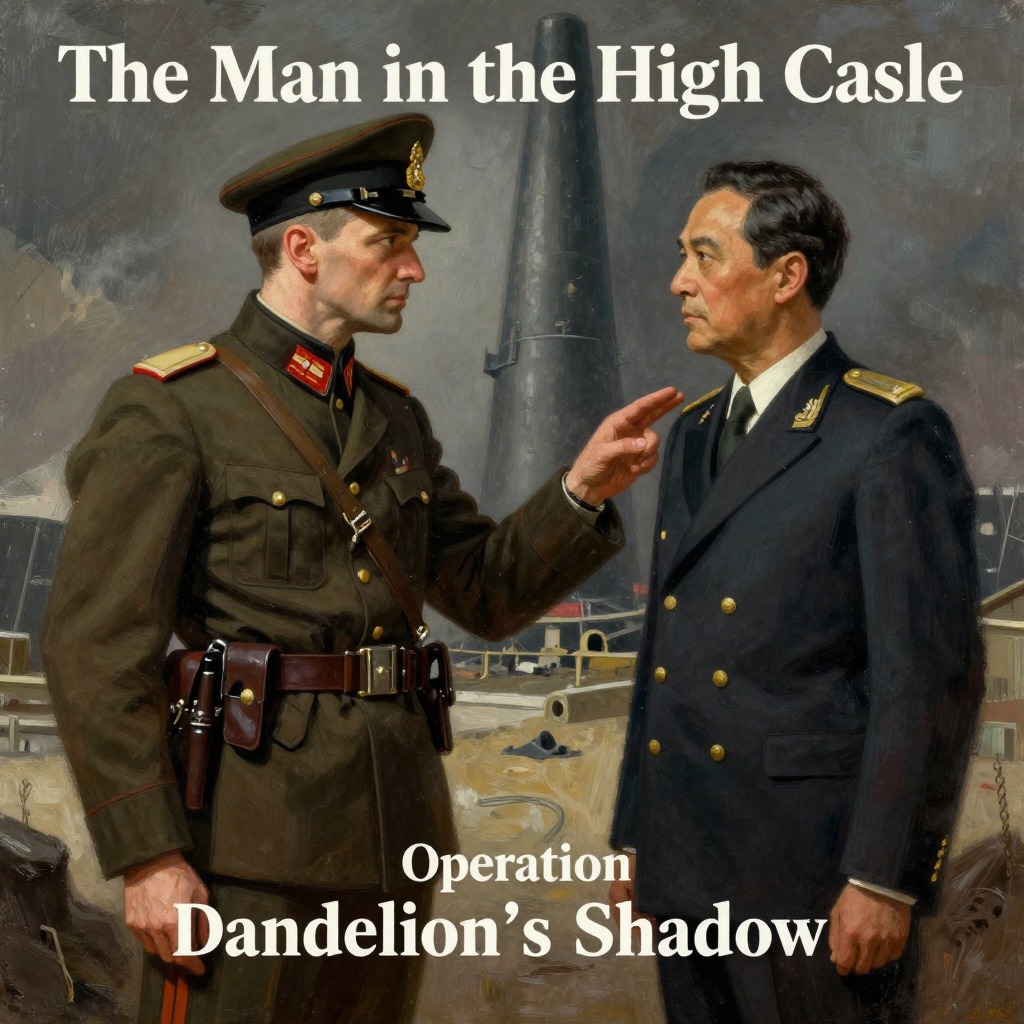
Tagomi's primary objective is to facilitate the secret meeting between Wegener and General Tedeki, a mission that places him at the center of a conspiracy to prevent Operation Dandelion, a Nazi plan for a nuclear attack on Japan. He acts as a cover, maintaining the fiction that Baynes is a Swedish businessman. When the SD attacks, he does not hesitate: he loads his antique revolver and fires, killing two men. After the attack, he confronts the German Consul, Hugo Reiss, and refuses to sign an extradition order for Frank Frink, a Jewish man arrested on trumped-up charges, scrawling "Release" on the form. This act of defiance, born from his moral revulsion, directly saves Frink's life.
Relationships and Conflict
Tagomi's relationship with Robert Childan is a master-servant dynamic, but it evolves. After his breakdown, he visits Childan's store to trade in the Colt .44, the gun he used to kill. Childan, sensing Tagomi's despair, refuses the trade and instead shows him a new line of contemporary American jewelry, the Edfrank pieces. Tagomi is initially unimpressed, but Childan's fervent belief in the objects as "the new life of my country" plants a seed. Tagomi buys one, a small silver triangle, and takes it to Portsmouth Square. There, in a state of near-mystical contemplation, he experiences a vision of the object as a union of yin and yang, a microcosm that momentarily breaks his despair. The vision is shattered by a policeman, but the experience marks a turning point. His conflict is internal: the horror of his violent act versus the necessity of it, and the search for meaning in a world he now sees as fundamentally evil.
Change and Ending
Tagomi's arc is one of disintegration and tentative reintegration. The killing of the SD men triggers a heart attack and a profound spiritual crisis. He wanders San Francisco in a dissociative state, seeing the Embarcadero Freeway as a nightmare and feeling utterly lost. The silver triangle, which he initially dismisses, becomes the catalyst for a moment of satori, a glimpse of the Tao that reconciles the dark and light. Though he suffers a heart attack immediately after signing Frink's release, he survives. The novel ends with him lying on his office couch, contemplating the oracle's hexagram of Inner Truth, and accepting that he may never fully understand, but that he must wait and see. He has not found a permanent answer, but he has found a way to continue.
Narrative Role and Evaluation
Tagomi is the novel's moral center and its most complex character. He is the only major figure who directly confronts the evil of the Nazi regime and acts on that recognition, not just politically but personally. His journey from a comfortable, rule-bound bureaucrat to a man who kills, suffers, and then seeks redemption through a piece of art embodies the novel's central themes: the nature of authenticity, the search for meaning in a fallen world, and the possibility of grace. His story provides the novel's most direct link between the political thriller plot and the philosophical meditation on historicity and the Tao. His final, fragile hope, symbolized by the silver triangle, offers a counterpoint to the novel's pervasive despair.